Place-names · 1940 · Industrial district
NIGHT RUN
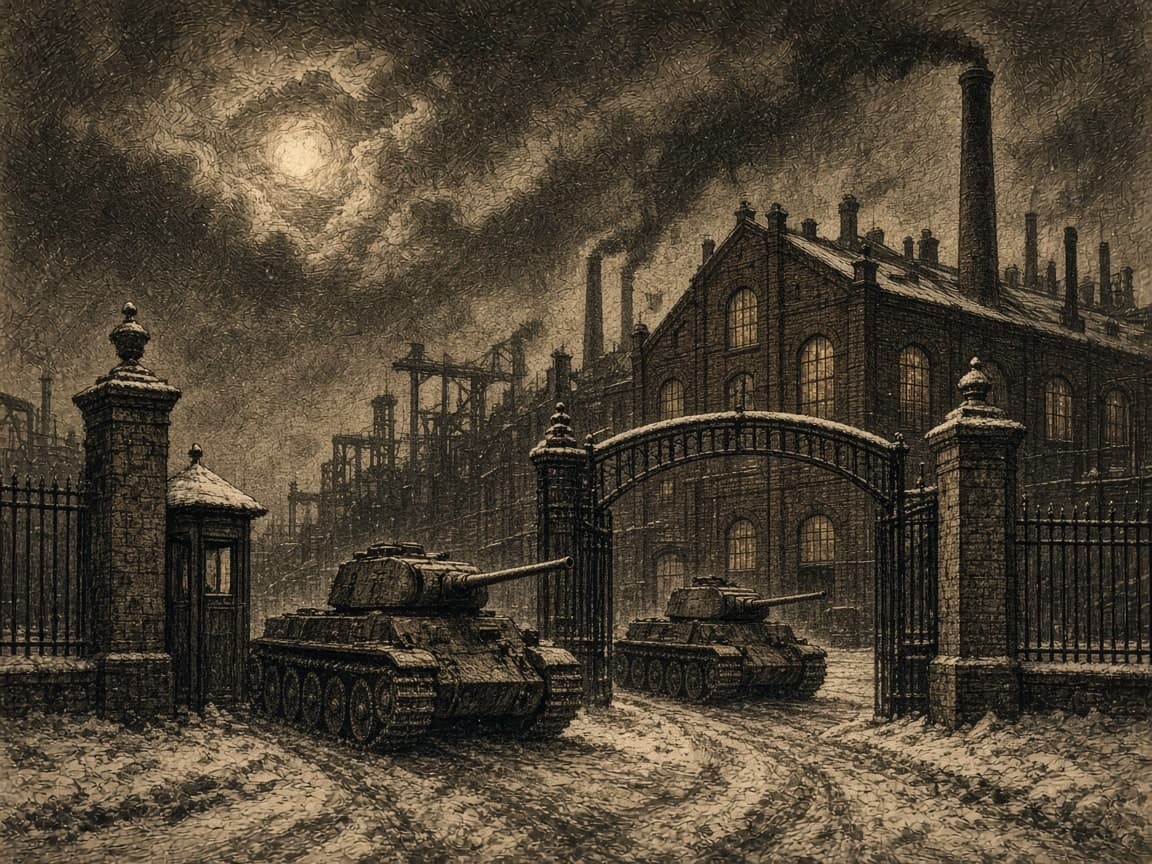
In March 1940, two tanks left the gates of the Kharkov Locomotive Plant. But instead of heading to the training ground, they headed for Moscow. For two days, in severe frost and blizzard, they moved towards the capital along snow-covered off-road terrain. We entered the Kremlin. There, on Ivanovskaya Square, the armored vehicles were shown by the top management. As a result, the People's Commissariat of Defense decided to put the T-34 tank into serial production. The cars also moved back under their own power. Chief designer M. Koshkin, who was traveling in one of them, caught a severe cold and soon died. He was replaced in this post by A. Morozov.
This review was preceded by such events. During the war in Spain, photographs of our tanks with holes were delivered to Moscow. This indicated that the Germans had anti-tank artillery. The armor of our vehicles could only withstand bullets. And then came the order to create a tank that would not be inferiorcompared to previous models in maneuverability and speed, but would have more powerful protection. And this one was created in the shortest possible time in Kharkov. It was a completely new type: armor plates were placed at an angle for the first time, the hull was welded rather than riveted, the turret was cast, and the gasoline engine was replaced by a diesel one. Their release at an assault pace began already in the Urals, where KhPZ was evacuated at the beginning of the war. From the gates of the Nizhny Tagil plant, armored vehicles were immediately sent to the front.
Hitler’s General E. Schneider wrote: “The T-34 caused a sensation. This 26-ton Russian tank was armed with a 76-mm cannon, the shells of which penetrated the armor of German tanks at a distance of 1.5-2 thousand meters, while German tanks could hit Russians at a distance of no more than 500 meters, and even then only if the shells hit the side or rear of the T-34.
Recognized as the best tank of the Second World War,The T-34 is installed as a monument on the pedestals of many European cities liberated by the Soviet Army. And its modern descendants, produced by the Kharkov Transport Engineering Plant named after. V. Malyshev (former KhPZ), and today they are quoted on the world arms markets.
This site is for all Kharkiv locals. Based on “Kharkiv in Tales and Anecdotes” (Folio, 2001).