Place-names · 1934–1953 · Centre
WITHOUT NAMING SURNAMES
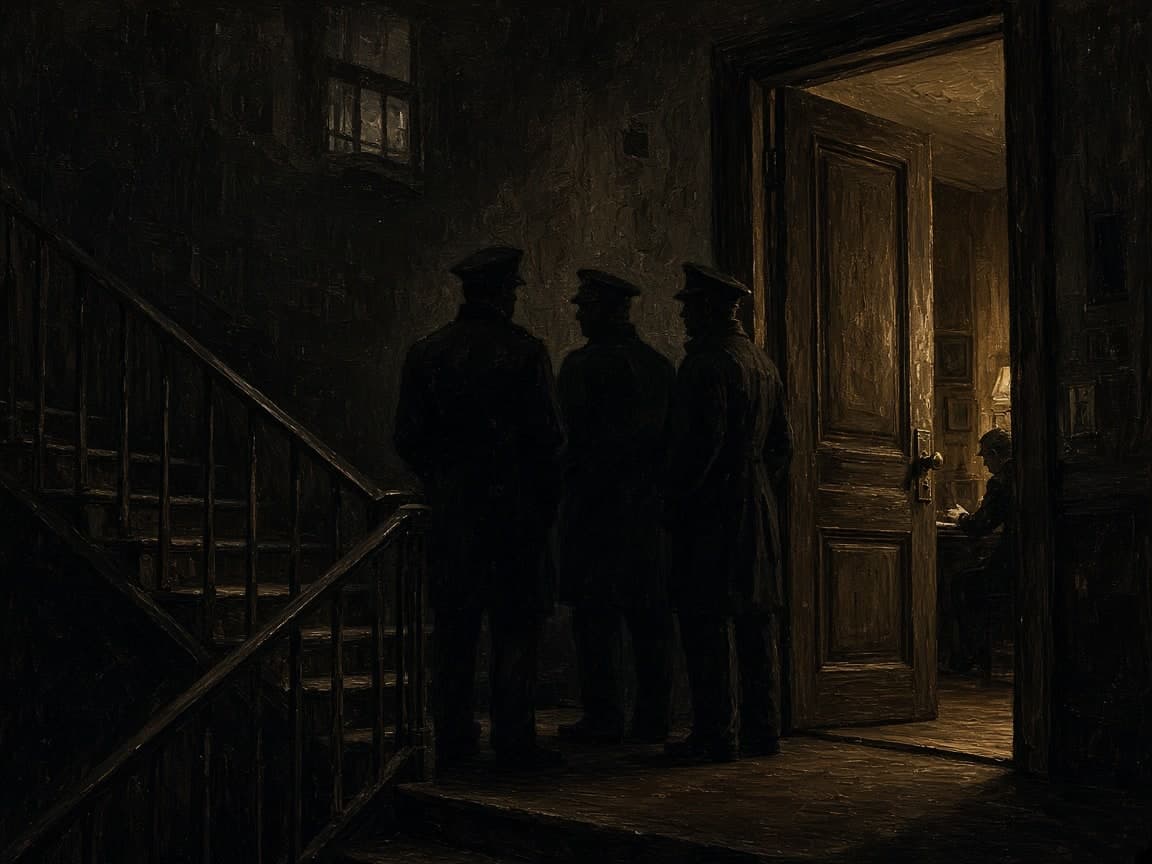
In the middle of the night, the writer V. Mysyk heard a knock. Opened it. Three people stood on the platform in NKVD uniforms - an officer and two soldiers.
-Where is your neighbor? - asked the commander.
- Which?
-Who lives above you.
“I have no idea,” Vasily Alexandrovich shrugged.
In fact, he guessed where his neighbor and namesake Vasil Minko could have disappeared (this happened in 1934 in a residential writer’s building at 118 Sverdlova Street). The day before, they discussed the arrests of their friends and acquaintances. Feeling that it might come to them, they said: it would be good to hide - preferably in a remote village - and wait out the dangerous times there.
“Then come with us,” said the NKVD officer.
- Why? - V. Mysyk objected. — Do you have an arrest warrant?
- Here! — the officer took out a piece of paper and showed it at a distance.
Although it was dark, Mysyk managed to see that it was not his name, but his neighbor’s.
“Let’s go, let’s go, we’ll figure it out,” he said.NKVD officer who did not want to return to Dzerzhinskaya empty from a night raid.
At the Kharkov Lubyanka, Mysyk continued to insist that he was taken by mistake, but they did not pay attention to this - the security officers had a task to arrest “enemies of the people” that should have been carried out. So, under the name “Minko”, Vasily Aleksandrovich went through all the interrogations and appeared before the highest authority - a special meeting of the GPU, which was chaired by its head Ulrich himself. There, Mysyk again denied all accusations and stated that he was in fact not the person listed in the case. This saved his life - most of the other defendants were sentenced to death, and the sentence was carried out immediately. Usually ruthless, Ulrich for some reason showed gentleness this time and ordered his subordinates to sort it out. They were forced to admit what they themselves knew: the arrest was made for show.
WriterI decided that they would let him go, but it didn’t work out that way - no one was released from here just like that. He was sentenced to five years in forced labor camps. Vasily Alexandrovich served them in Solovki. He returned to Kharkov under Khrushchev. He again took up literary work and distinguished himself as a major poet and translator.
Vasil Minko, meanwhile, actually took refuge in his native village of Minkivka, not knowing that his friend was serving his sentence “in his place” (if this “mistake” had not happened, he would probably no longer be in the world). In addition to prose, after the war he took up drama. In 1953, his satirical comedy “Don’t Call Nicknames” was staged in Kyiv and Kharkov. As a schoolboy, I saw her on the stage of the Kharkov Theater named after T. Shevchenko. The thing was remarkable, truly funny, as far as was possible in those harsh times (played by P. Kumanchenko, L. Bykov and other luminaries).
Places in this story
This site is for all Kharkiv locals. Based on “Kharkiv in Tales and Anecdotes” (Folio, 2001).