Place-names · 1918–1920 · Centre
CITIZEN OF THE SKY
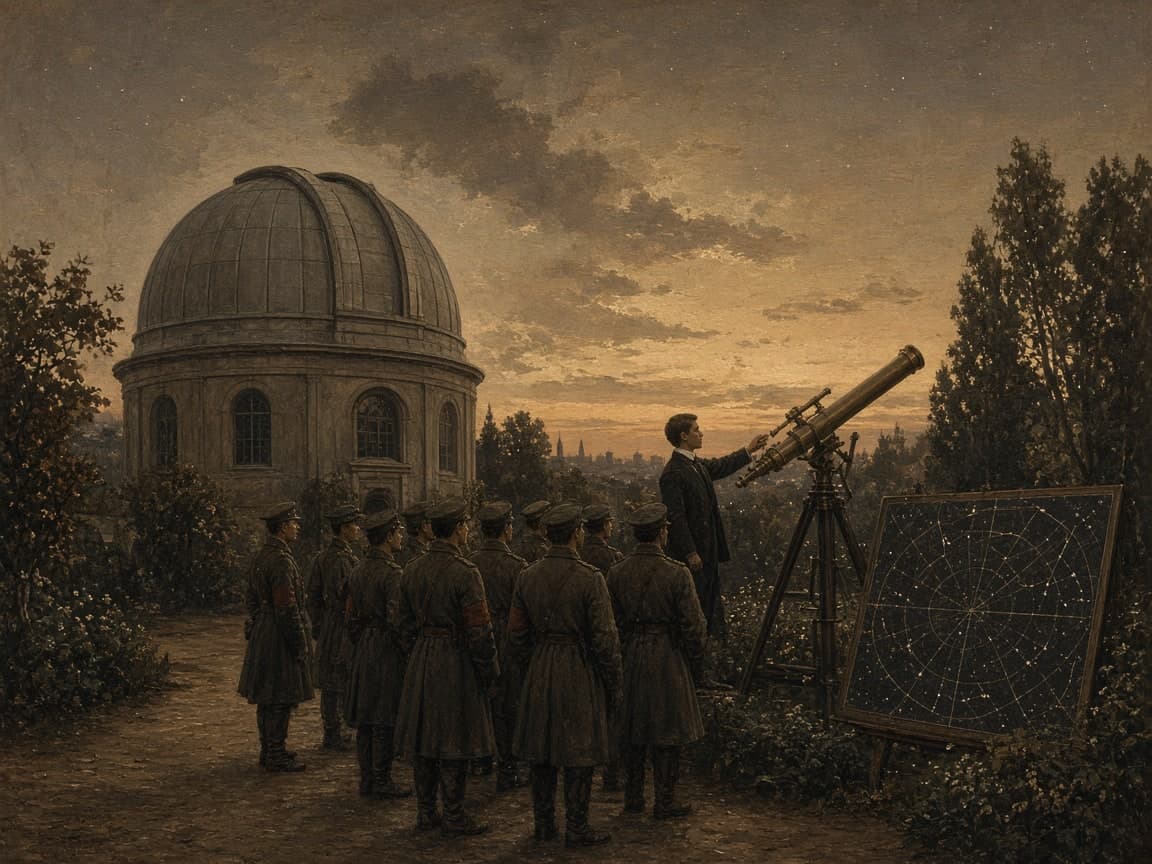
1920th. A detachment of Red Army soldiers stopped near the observatory in the University Garden. They were met by the manager, a young man. The commander asked to talk about astronomy and show the instruments.
“There’s nothing to show here,” answered the manager. — The device does not work because the mirror needed for operation should be coated with silver.
“But he’s not there,” the commander prompted.
- There is silver, but there is no sugar - without it it is impossible to do this.
The next day a gig drove up to the observatory, and the soldier dropped a bag of sugar.
- Why do I need so much? — the scientist was surprised. - Just a few tens of grams will be enough!
“Nothing,” answered the messenger. “The commander said: let him make his own mirror and... drink tea.”
This astronomer was Nikolai Pavlovich Barabashov. He continued the path bequeathed to him by his famous colleague K. Flammarion. Already at the age of fifteen, he published his first stories in French and Russian magazines.reports of observations of the Moon and Mars. The astronautics theorist K. Tsiolkovsky drew attention to them and
sal to the author from Kaluga. A correspondence began. It is unlikely that the old scientist knew that his Kharkov correspondent was just a high school student.
In the attic of a house on Zmievskaya Street (now Gagarin Avenue), Barabashov set up a small home observatory, where he performed a lot of interesting work. Having received a university diploma, Nikolai Pavlovich got a job at his observatory as a supply manager (only this position was available there). He studied Mars, the rings of Saturn, but his biggest discovery was related to the Moon. For the first time, back in 1918, the scientist concluded that its surface was highly porous. This acquired practical significance in the 70s, when the question arose of landing spacecraft on the Earth’s satellite, and then man himself. It was assumed that the Moon was covered with a thick layer of dust due to frequent meteorite impacts,which you can fail. However, Barabashov stated: its surface is of volcanic origin and made of tuff, which was confirmed. Subsequently, Nikolai Pavlovich participated in the compilation of an atlas of the far side of the Moon and a lunar globe. He was a highly educated man and was fond of music. He himself made an electronic musical instrument, the Theremin Vox, and played it.
After the liberation of Kharkov from the Nazis, Barabashov was appointed rector of KhSU, elected a member of the Academy of Sciences of Ukraine, and head of its Astronomical Council. He was awarded the title of Hero of Socialist Labor. Since the old observatory on the territory of the garden named after. Shevchenko became cramped, the scientist sought to build a new one, with a powerful telescope. They chose a hill near Kharkov for it, but construction never began.
Places in this story
This site is for all Kharkiv locals. Based on “Kharkiv in Tales and Anecdotes” (Folio, 2001).