Rumors · 1923–1956 · Centre
A BERRY OF LOVE
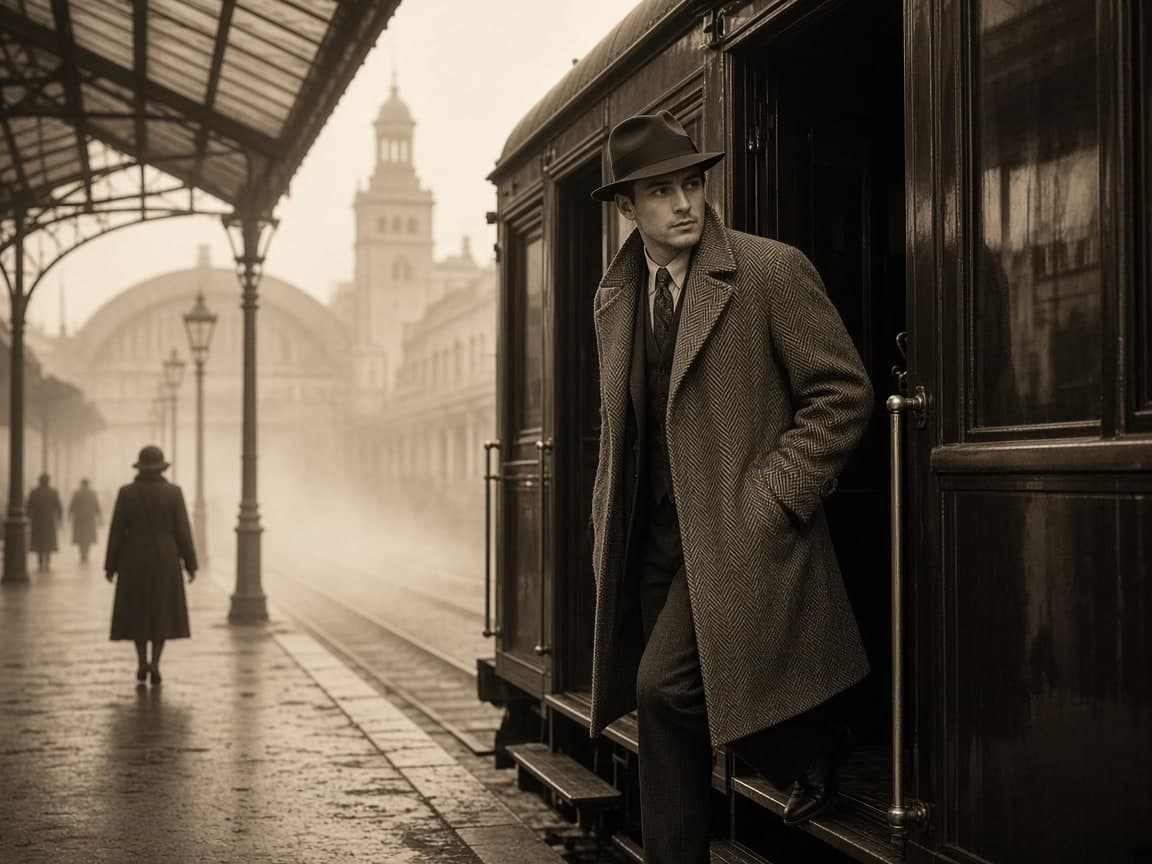
A young man, slender, tall-haired, wearing a felt hat and an open gray herringbone coat, from under which an apache shirt was visible, came out of the train carriage that arrived in Kharkov. This is the former secretary of the Ukrainian consulate in Berlin. He never returned to Germany. The newcomer settled in a two-story mansion at 62 Pushkinskaya Street, converted into a dormitory. He called the room he occupied with a journalist “the Majlis.” In it, everyone sat on boxes placed along the walls, and the owners slept on the same boxes. Almost half a century later, a memorial plaque will appear here: “In this budinka he lived 1923-1926. Oleksandr Petrovich Dovzhenko - eminent Ukrainian Radiansky kshorezhi-ser 1 scribe.”
When A. Dovzhenko lived in this house, he was neither one nor the other. In Germany, he took painting lessons and planned to become a professional artist. And he became one by going to work incentral republican newspaper "Vyut". Many of his cartoons on political and everyday topics, friendly caricatures of the country's leaders and figures of Ukrainian culture appeared in this and other publications. “Sashko” (as the author signed himself) became famous.
He also collaborated with VUFKU (All-Ukrainian Photo and Film Administration - the then Ministry of Cinematography), making advertising posters for new films for him. The art that was new at that time attracted people with its possibilities. In Kharkov, Alexander Petrovich composed scripts, or rather, plots of the comedy short films “Vasya the Reformer” and “Berry of Love”. But how to implement them? The decision came one night. And in one
In the days of June 1926, he collected his simple belongings and left for Odessa to the film factory. This is how “Sashko” ended and Alexander Dovzhenko began.
Another story on the topic “Dovzhenko and Kharkov”. In his film "Shchors" the hero of the film dies in the arms of hisbrother-in-arms of Ivan Dubovoy, later commander of the Kharkov Military District. Stalin did not like this ending, and he advised to redo the script so that Shchors was supposedly killed by Dubova, who was declared at that time an “enemy of the people.” At the same time, he showed the protocol of his “confessions.” But Alexander Petrovich knew Dubovoy well, believed in his innocence and refused to remake the film. Then the ending of the tape was cut out altogether, and the leader of the people harbored hostility towards the obstinate artist.
A. Dovzhenko visited Kharkov in the very first days after its liberation from the occupiers - as a member of the Extraordinary Commission to establish and investigate the crimes of the Nazi invaders. He wrote in his diary: “On the night of August 23, we occupied Kharkov. The Germans fled from it as a result of our circular offensive. In the afternoon I went to the city. The city is half dead. A sad, sick, humiliated city."It is noteworthy that the master’s last film, “Poem of the Sea,” is also connected with our city: to film it in 1956, he invited an actor from the theater named after. T. Shevchenko Leonid Tarabarinov, who was later one of the few in Kharkov who was awarded the title of People's Artist of the USSR.
A unique work dedicated to our fellow countryman was carried out by Kharkov resident N. Kutsenko, who collected and published the book “Stories of Life 1 creative work of O.P. Dovzhenko,” where, day by day, the biography of this outstanding artist and person is traced.
This site is for all Kharkiv locals. Based on “Kharkiv in Tales and Anecdotes” (Folio, 2001).