Legends · 1904–1924 · Kholodna Hora
A LIFE OF STRUGGLE
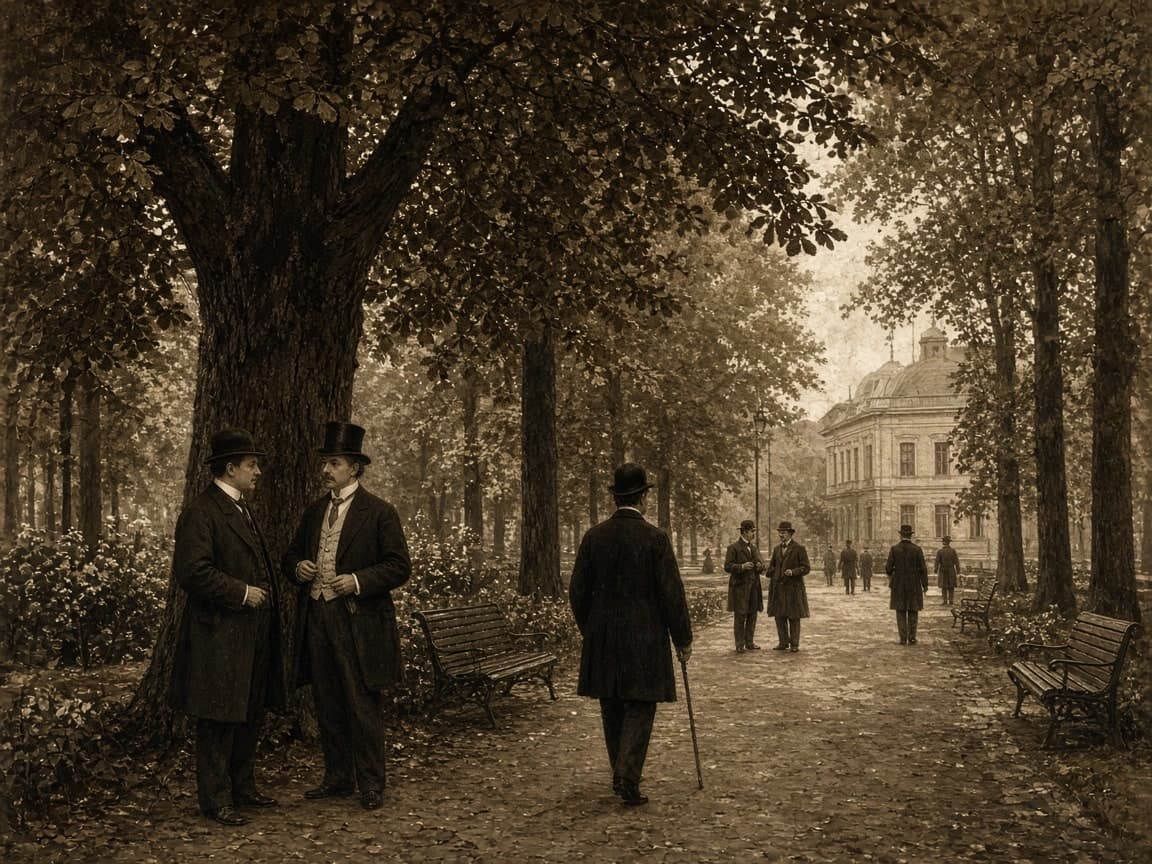
Spring 1904. University Garden. Among the walking public is a group of gentlemen. At first glance, it is impossible to imagine that these peacefully talking respectable men are the leaders of Russian revolutionary terrorists, and they are planning an assassination attempt on the Minister of Internal Affairs Plehve himself. For dispersing a student demonstration in St. Petersburg, he was sentenced to death. A few months later, the minister was killed, and with dynamite made in our city.
Among the conspirators (E. Azef, E. Sazonov, I. Kalyaev) was Boris Viktorovich Savinkov. A native of Kharkov, he joined the revolutionary movement as a student. At first he shared the views of the Social Democrats, but then became disillusioned with them and joined the Socialist Revolutionaries. He became one of the most active and influential figures of this party, a truly legendary person. The authorities repeatedly arrested Savinkov and even sentenced him to death, but he managed to escape.Engaged in revolutionary activities, he traveled throughout the Russian Empire and Europe.
Churchill, who knew Savinkov personally, gave him a worthy place in his book with the expressive title “Great Contemporaries.” He assessed him as a man who "combined the wisdom of a statesman, the qualities of a commander, the courage of a hero and the fortitude of a martyr." A. Lunacharsky spoke much more derogatory about our fellow countryman and his colleague in literary work: “Savinkov is a highly theatrical person. I don’t know if he always plays a role in front of himself, but he always plays a role in front of others... Savinkov fell in love with the role of a “servant of the people,” whose service, however, boiled down to satisfying his insatiable ambition with more or less picturesque exploits and the desire to constantly attract everyone’s attention.” I must say, such a review is very strange - about a person who more than once actually stood onthe threshold of death.
And here’s how A. Tolstoy described Savinkov in his trilogy: “He held a silk handkerchief to his mouth with his left hand, covering his dark or, perhaps, made-up face... Abrupt, confident phrases, commanding voice, cold eyes. He was short, wearing a soft hat, a protective, well-tailored coat, and leather leggings. Both in his clothes and in his precise movements he looked like a foreigner, he spoke with a St. Petersburg accent, in an uncertain, muffled voice...”
A man of versatile talents, Boris Viktorovich also became famous in the literary field: his novel “The Pale Horse,” signed under the pseudonym V. Ropshin, was an extraordinary success.
After the revolution, Savinkov became a military commissar in the Kerensky government. When the Bolsheviks came to power, he launched a fierce struggle against them, considering them gravediggers of democracy. During the Civil War he visited the white commandersarmies, inspiring them to overthrow Soviet power. For the same purpose, he visited the leaders of Western countries.
In the end, the OGPU, in order to put an end to its worst enemy, decided to lure him to Soviet territory. It was a large-scale operation, during which the security officers created a number of fake underground organizations and the Liberal Democracy party. The success of the operation was ensured by some of Savinkov’s former associates who had been recruited by the OGPU. Cautious and distrustful, he nevertheless “pecked at the bait” and was arrested in Moscow in August 1924. That same month, the Military Collegium sentenced him to death. However, the accused repented, and the execution was replaced with a ten-year sentence. According to the official version, in May of the following year, Savinkov jumped out of the window of the fifth floor of the internal OGPU prison on Lubyanka. However, there is evidence that the security officers threw him into the stairwell of the same prison.
SoThe life of one of our legendary fellow countrymen has ended. At the time from which our story began, Boris Viktorovich often came to his homeland, to Kharkov.
This site is for all Kharkiv locals. Based on “Kharkiv in Tales and Anecdotes” (Folio, 2001).