Tales · 1926–1931 · Centre
BIRTH OF A GIANT
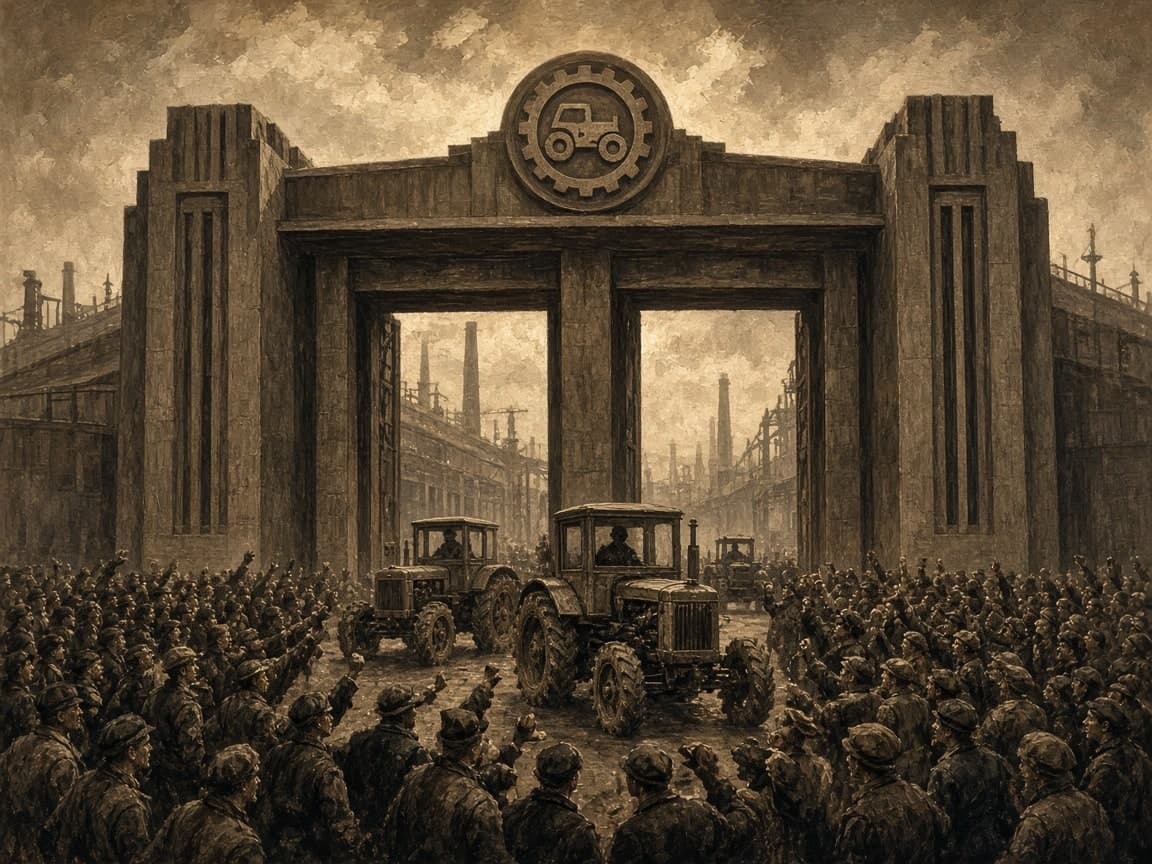
In October 1931, the giant of socialist industry, the Kharkov Tractor Plant, was put into operation. This was the biggest event in the life of the country. It was decided to hold the ceremonial meeting and award ceremony for the builders in the premises of the Bere-zil Theater (now the T. Shevchenko Theater). After the meeting there was a big concert planned. But the artistic director of the theater, Les Kurbas, proposed something else: to create a review performance using documentary materials from living history, in which the shock workers of the KhTZ construction would recognize themselves on stage.
The theater turned into a battle arena. Everyone who wanted and knew how to write competed in creating episodes of the play. We worked day and night, studying documents, carefully re-reading wall newspapers and newspapers, looking at portraits of shock workers. The texts were quickly written down and immediately passed on to directors and actors. The whole team was involved in the performance. The artists workedpassionately, improvising during rehearsals, the artists created the design on the fly, selected costumes, and edited the music. “Bere-zil” was like a ship in a stormy sea when the rush called everyone up. Kurbas, like a captain on a ship's bridge, confidently directed the creative energy of the team. This is how the play “Birth of a Giant” appeared. However, lacking a solid dramatic basis, it remained a one-day project.
This was not a very successful example of how the director sought to keep up with the times. For him, KhTZ, as a symbol of industrialization, was also a symbol of revolutions - both technical and social. In his opinion, art should also be revolutionary updated. One of the most educated people of his time (he studied at the Universities of Vienna and Lviv), an expert on world culture, Kurbas became the first destroyer of the old traditional theater in Ukraine. He considered him bourgeois, whomust be replaced by the theater of the new world. He embodied new stage forms in the “Berezol” he created, which in 1926, by government decision, was transferred from Kiev to the capital.
Here Les Kurbas's talent as an innovative director, theater theorist and teacher was fully revealed. On the stage of "Berezol" original plays were staged, showing that the director is at the forefront of not only domestic but also world theater. They aroused keen interest from the audience and heated discussions in the press and theater circles. The artist took an active part in the literary and social life of the city. He became a symbol of the progressive development of Ukrainian culture, its “Europeanization”, the prototype of the new Ukrainian intellectual.
However, over time, the innovative positions and techniques of L. Kurbas began to be perceived negatively ideologically.231
?;•
skiy leadership, they were considered to be contrary toofficial settings. The play “People's Malachi” based on the play by M. Kulish was especially destroyed. L. Kurbas was fired, and “Berezil” was reorganized into the Kharkov Ukrainian Drama Theater named after. T. Shevchenko. For some time the director worked in Moscow, but was arrested there, convicted and imprisoned in the Solovetsky camp, where he died. In one of the cemeteries in Kharkov, the Kurbasov Memorial was created, where his mother, wife, and also the so-called ashes of the artist, a classic of world theater, are buried. The small stage of the theater named after him is named after the theater he founded - “Bere-zil”. T. Shevchenko.
This site is for all Kharkiv locals. Based on “Kharkiv in Tales and Anecdotes” (Folio, 2001).