Place-names · NOBEL LAUREATES · 1908–1916 · Centre
ILYA MECHNIKOV
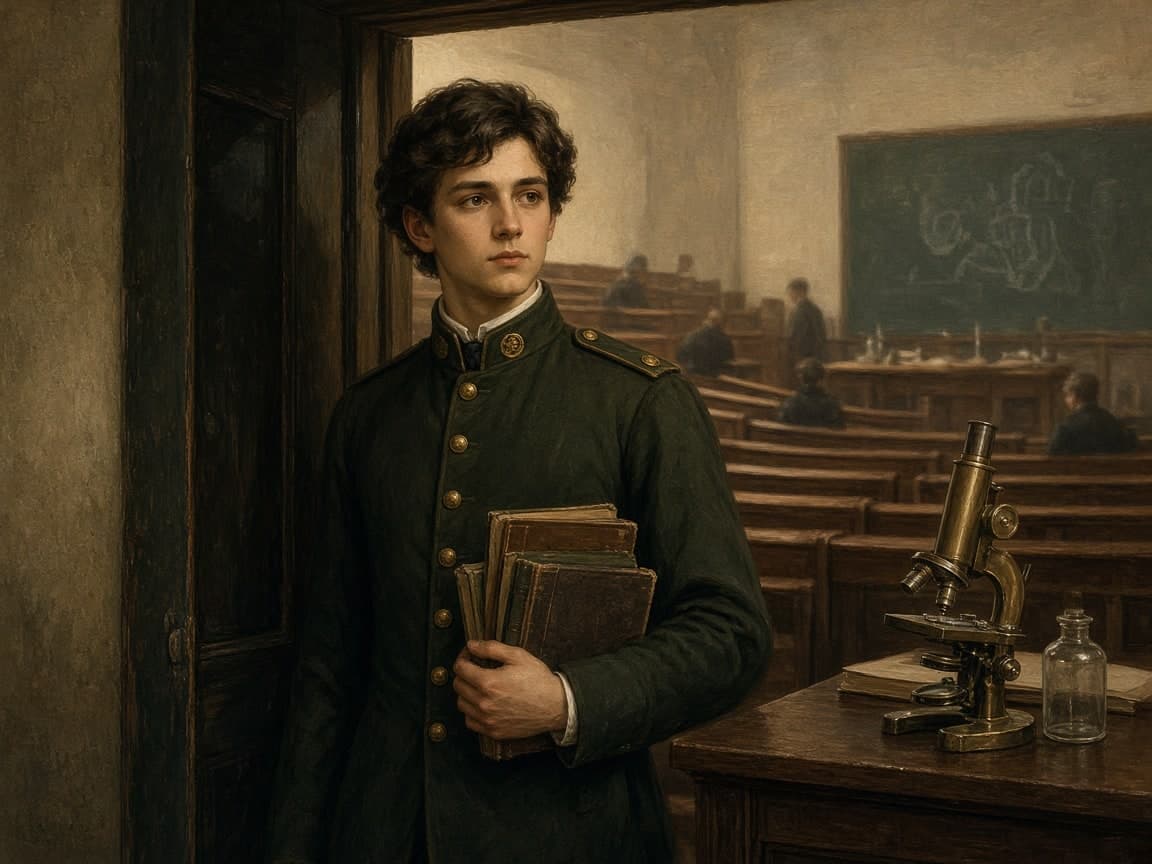
At the gymnasium, Ilya and his classmates organized the “Union of Science”. They organized debates and wrote abstracts on scientific issues. While still a high school student, the young man first crossed the threshold of Kharkov University and began working in one of the laboratories. The result was his first publication in a scientific journal. After high school, Ilya entered the Faculty of Physics and Mathematics of Kharkov University and completed its course in just two years.
Having received a university diploma at the age of nineteen, Mechnikov went abroad to continue his education and improve his qualifications. Returning to Russia, Mechnikov defended his master's thesis in St. Petersburg, and a year later his doctoral dissertation. In those same years, he began working at Novorossiysk (now Odessa) University, where he soon became a professor (at only twenty-five years old). Here the scientist founded one of the fields of biology - evolutionary embryology. In Odessa heopened and launched the activities of the first bacteriological station in Russia.
A man of progressive democratic convictions, Mechnikov left the university as a sign of protest against the rampant reaction. The outstanding scientist L. Pasteur invited him to head his laboratory at his institute in Paris. Our fellow countryman was in charge of it until his death in 1916. In 1908, Ilya Ilyich was awarded the Nobel Prize for his work in the field of immunology. A street in our city bears his name, the Research Institute of Microbiology and Immunology.
Note that Mechnikov was a descendant of one of the Moldovans who, fleeing Turkish enslavement, together with their ruler D. Cantemir, were forced to leave their land and move to the Kharkov province.
People in this story
This site is for all Kharkiv locals. Based on “Kharkiv in Tales and Anecdotes” (Folio, 2001).