Place-names · 1923–1999 · Kharkiv
KHARKIV FORGED AND RAISED ME
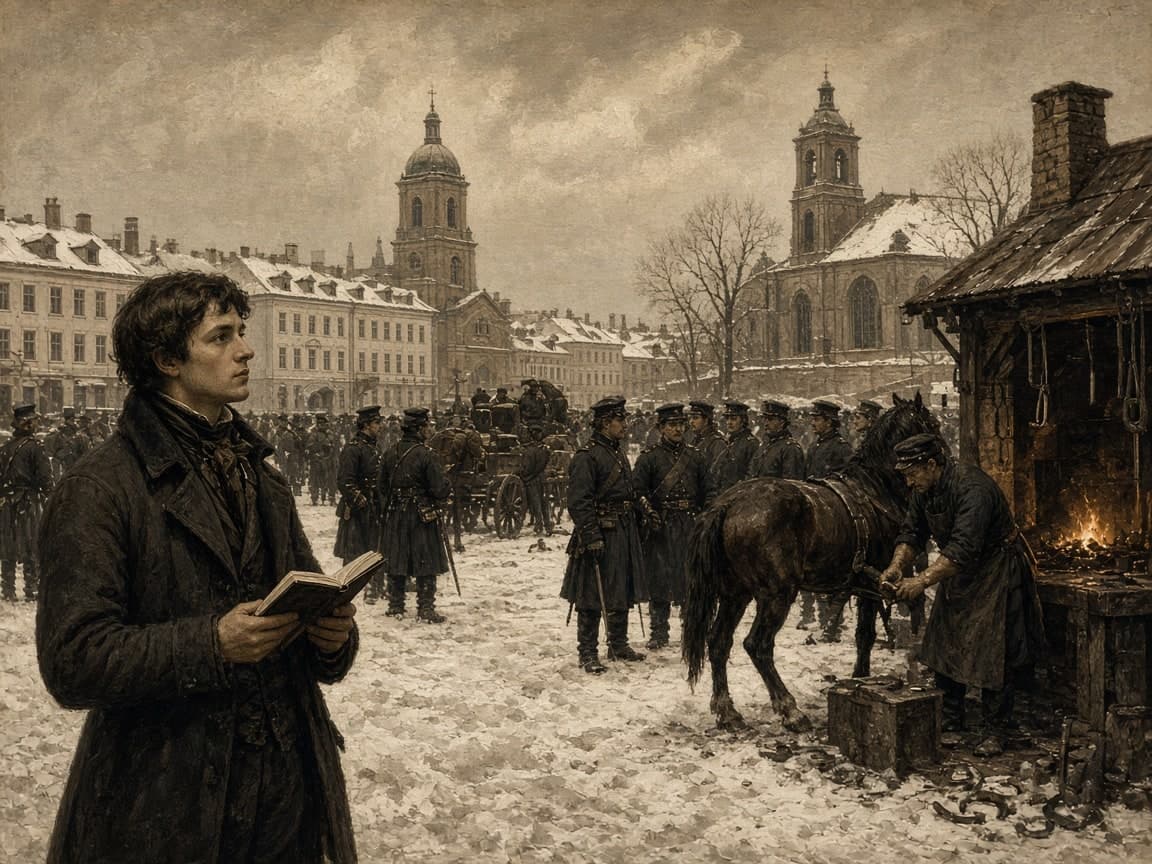
“On the Maidan” was and remains the most famous poem of the Civil War - this poetic masterpiece embodied the entire essence of the events of those years. Its author, then still very young Pavlo Tychyna, having published the collection “Solar Clarinets”, became a famous poet. In 1923, he moved to our city and began working
in newspapers and publishing houses, became involved in the cultural and social life of the capital.
“Pavlo Grigorievich, the first poet of Ukraine, huddled in the editorial office of the newspaper “V1st1” in a cramped kennel - a former bathroom. The bathtub was thrown out and furniture was put in its place: a table and a stool. Pavlo Grigorievich did not have a bed: there was a pile of unsold newspapers in the corner, a soldier’s gray blanket was thrown over it - that’s all. And perhaps also four canned ARA (condensed maize milk) cans with water: a table stood in them with four legs so that mice and rats could not climb on it and chew itmanuscripts of Pavel Grigorievich.
Over time, Pavel Grigorievich’s housing conditions improved: he received a room on Moskovskaya Street, in which house - I don’t remember, just opposite number twenty, where Proletkult was located. A room on the ground floor, in the wing facing the courtyard. This time it was... a kitchen, probably in a once fashionable apartment, with a tiled black and white floor. The large stove served Pavel Grigorievich as a desk, the oven served as a bookcase, and Pavlo Grigorievich put his manuscripts in a cauldron for boiling clothes built into the stove.
A year or two later, housing became even better: Pavlo Grigorievich settled on Kaplunovskaya Street - opposite the Art Institute, next to the estate of the Technological Institute - in an old two-story house... Around the beginning of the thirties, living conditions were finally established: the Writers' House "Slovo" was built, and Pavlo Grigorievichreceived a three-room apartment... Quiet, meek, delicate Pavlo Grigorievich was surprisingly hardworking: he worked at the table from early morning until late.
However, as for Pavel Grigorievich’s gentleness, which even became a proverb, it did not at all mean softness. Each of the poets who began their poetic journey, using Tychyna’s creative advice - and such is the vast majority among all generations of modern poets - knows how strict Pavlo Grigorievich was in his demands, uncompromising in his judgments, and firm in his creative principles: he did not allow the slightest reduction in demands and did not forgive a single mistake...
The delicacy, gentleness, and kindness of Pavel Grigorievich were not only combined in him with the unshakability of principles and decisions, but did not exclude harshness in anger” (Yu. Smolich).
In 1934, together with the leadership of the Writers' Union, P. Tychina returned to his native Kyiv. ButKharkov still remained so dear to him that he arrived there on the very first day of liberation from the Nazi invaders. He was wounded on the highway in Pomerki, and the poet was treated for some time by his friend in an apartment on Frunze Street. Here he was visited by N.S. Khrushchev and A.N. Tolstoy. This house is marked with a memorial plaque.
Having left our city in 1934, Pavel Grigorievich noted in his notebook: “... like you, Kharkov, that I, an old Kiyan, having worked in you, now turn around to Kyiv. I am a giant of the glorious city of Kharkov."
In honor of the poet’s 85th birthday, another memorial plaque appeared on the house on Kultury Street - with a bronze high relief and the inscription: “Haryuv mene pschkuva ta vikhovav. Here, at the Slovo booth, in 1929-34. alive 1 pratsyuvav sings-academy, Hero Soschalutichno! Pavlo Grigorovich Tichina’s sling.” Bronze played a fatal role with this memorial sign: inOne night in 1999, a non-ferrous metal hunter tore it out of the wall and sold it for scrap.
This site is for all Kharkiv locals. Based on “Kharkiv in Tales and Anecdotes” (Folio, 2001).