Tales · 1923 · Centre
BUTI-MUTI
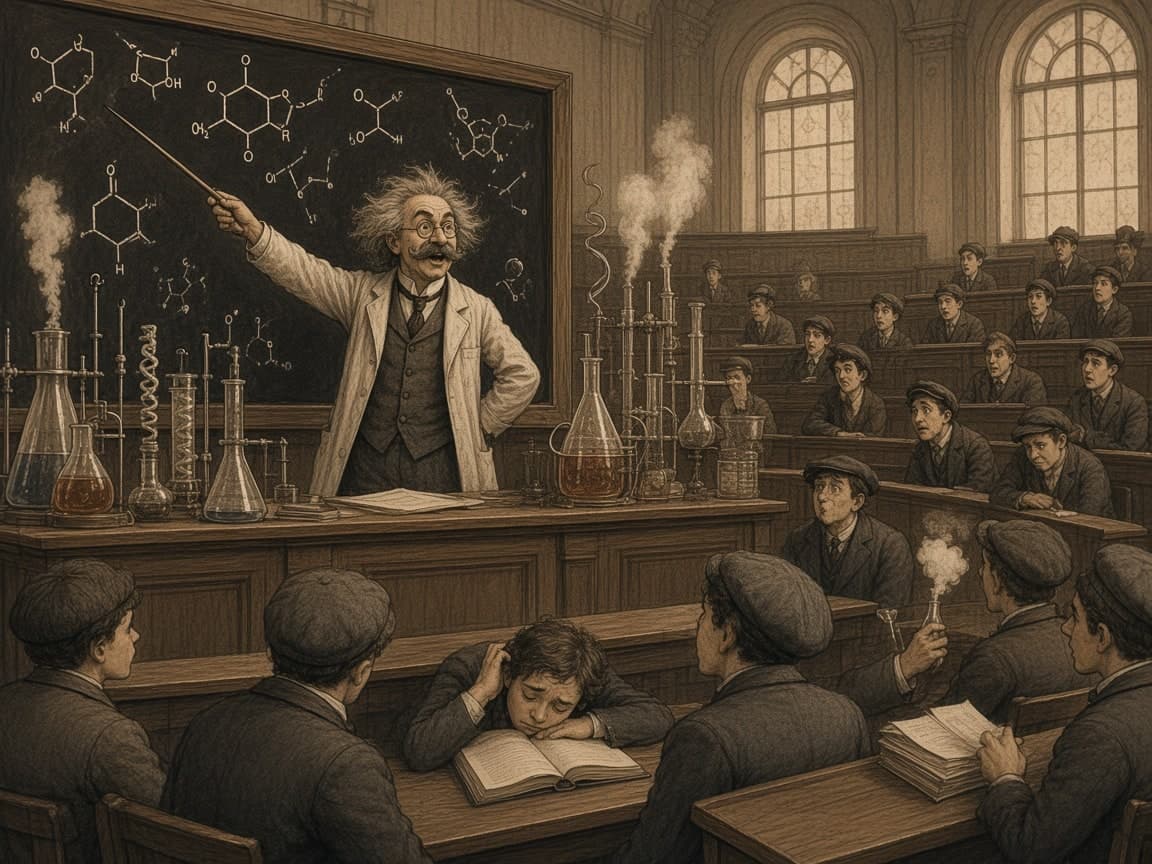
There were practical classes in chemistry at Kharkov University (at that time it was called the Institute of Folk
education). Explaining to the students a certain chemical reaction, the professor mixed the ingredients in a flask and announced: “It is not the vessel’s fault that it is cloudy,” which meant: “the solution must be transparent.” After which the professor received the nickname BUTI-MUTI.
From time immemorial, official teaching in Kharkov was conducted in Russian, textbooks were also in Russian, office work was also conducted in it, and therefore the directive received in April 1923 to switch to Ukrainian came as a surprise. All government agencies, government agencies, enterprises, design, scientific and public organizations, universities and schools were required to switch to the Ukrainian language, and in the shortest possible time. A massive replacement of forms, seals, stamps, typewriter fonts, and the production of dictionaries began. Since there are no teaching staffenough, they immediately began to be trained, including in specially created pedagogical institutes. Numerous courses were organized. Employees were required to pass language proficiency exams by a certain date; those who did not pass were subject to dismissal as politically unreliable. Not limited to the territory of the republic, the process was extended to the adjacent regions of Russia, where a significant number of Ukrainians lived.
The reason for this turn was not at all in the implementation of the right of nations to self-determination, proclaimed at one time by V. Lenin. On the contrary, the civil war in Ukraine showed that the ideas of Bolshevism were alien to its population for the most part, and therefore the idea of attracting it with the help of the “national question” arose in Moscow.
During this period, national culture flourished like never before. Thousands and thousands of people from the people got the opportunity to reveal their writing,acting or artistic talent. The Renaissance embraced both traditional literature and art, as well as new forms born after the revolution. In the early 1930s, Moscow considered its political goal achieved and ended the campaign as abruptly as it had begun. Moreover, its leaders and intelligentsia were declared Ukrainian bourgeois (?) nationalists and were subjected to repression, as a result of which only a few survived.
The period of Ukrainization lasted only ten years, but the achievements of national culture during that period were so great that they still feed it.
This site is for all Kharkiv locals. Based on “Kharkiv in Tales and Anecdotes” (Folio, 2001).