Place-names · 1910–1924 · Centre
WITHOUT BRAKES
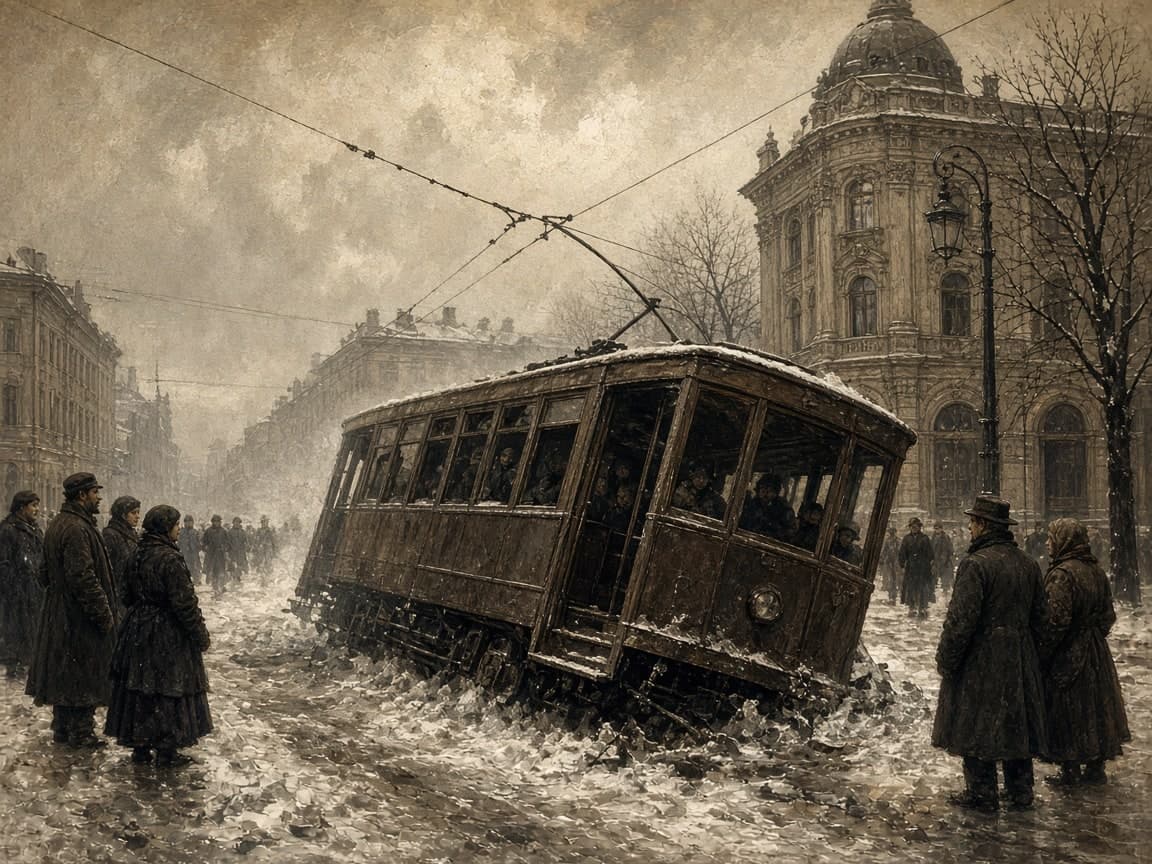
The townspeople witnessed a terrible picture: a tram was rushing down Pushkinskaya at full speed without stopping, at the turn to the library named after. Korolenko capsizes. People were killed, including the conductor, and many were injured. It turned out that the driver’s handbrake had failed (the cars were not equipped with electric or air cars). After this accident, the tram track was moved from Korolenko Lane to Tevelev Square (now Constitution). In addition, the tracks were switched to a wide gauge.
The appearance of the first trams was significantly different from the current one. Ahead was a motor carriage, which Kharkov residents called a “gander”. There was a counselor in it. Passenger cars clung to the gander. They had no doors, so people hung on the steps. Under the carriage windows there were frames on which one could stand, holding the window frames with one's hands. The buffers behind the cars (theircalled "sausages"). Moreover, not only boys, but also a very respectable public rode the “sausage”. However, the author observed a similar picture in the post-war period.
“I came to study with you,” he said.
- Where? - asked the director.
- From Lokhvitsa.
- What do you want to play?
- On the violin. I already know a little.
- But you arrived late - our reception was already over.
And yet the director decided to listen to the boy. He was so amazed by his abilities that he called his colleagues, and they gave the boy an exam. As a result, he was enrolled in the violin class. Thus, in 1910, the Kharkov period of the biography of Isaac Dunaevsky began.
At the same time, Dunaevsky studied at the gymnasium, which he graduated with a gold medal. A year later, he received a diploma from the conservatory, into which the music school was transformed. After that, he entered the university at the Faculty of Law, but did not study there for long and became fully involved in music.He entered the drama theater orchestra as a violinist, led by the famous director N.N. Sinelnikov. Dunaevsky began writing music for performances, giving them a bright sound. He began to manage the musical part of the team.
At the same time, he collaborated with the miniature theater, creating cheerful music for it. But not only that - being a cheerful, witty person, he himself helped to compose interludes and participate in directing. He also wrote music for many popular Kharkov and Moscow pop artists. The young composer became known throughout the country.
In 1924, Dunaevsky was invited to head the musical part of the Moscow Hermitage Variety Theater. A new period in the life and work of a wonderful composer has begun, without whose melodies it is impossible to imagine the life of the country in the pre- and post-war years. A memorial plaque on a house on the street reminds us of him in our city. Petrovsky, where he lived.
This site is for all Kharkiv locals. Based on “Kharkiv in Tales and Anecdotes” (Folio, 2001).